Saturday, 23 September 2017

A trip to Turkey and a visit to Ephesus

The ancient site of Ephesus; where on earth do I start?

Ephesus, or Efes in Turkish, is singularly one of the most amazing places I have ever visited. A visit was one of the things to do on my 'bucket list' and now that I've been I really want to go back!

Having read about Ephesus I thought I was prepared for what awaited me, how wrong I was. I knew about the Library of Celsus, the Grand Theatre (Odeon), the Government Agora and the Temple of Artemis, but although these are spectacular main attractions they are only the tip of the iceberg. My biggest regret was the lack of time our trip allowed us to explore all there is to see.

The first thing to strike you as you enter through the North Gate is simply how huge Ephesus is. You are confronted almost immediately by the Varius Bath standing opposite the Government Agora, an early Parliament if you will, and adjacent the Odeon (Bouleterion - not to be confused with the Grand Theatre). It is at this point you realise some of the buildings you expected to see are still hidden from view and just how large the city of Ephesus was.

Varius Bath
State (Government) Agora
Varius Bath leading to Basilica and Odeon
Vicinity of the State Altar

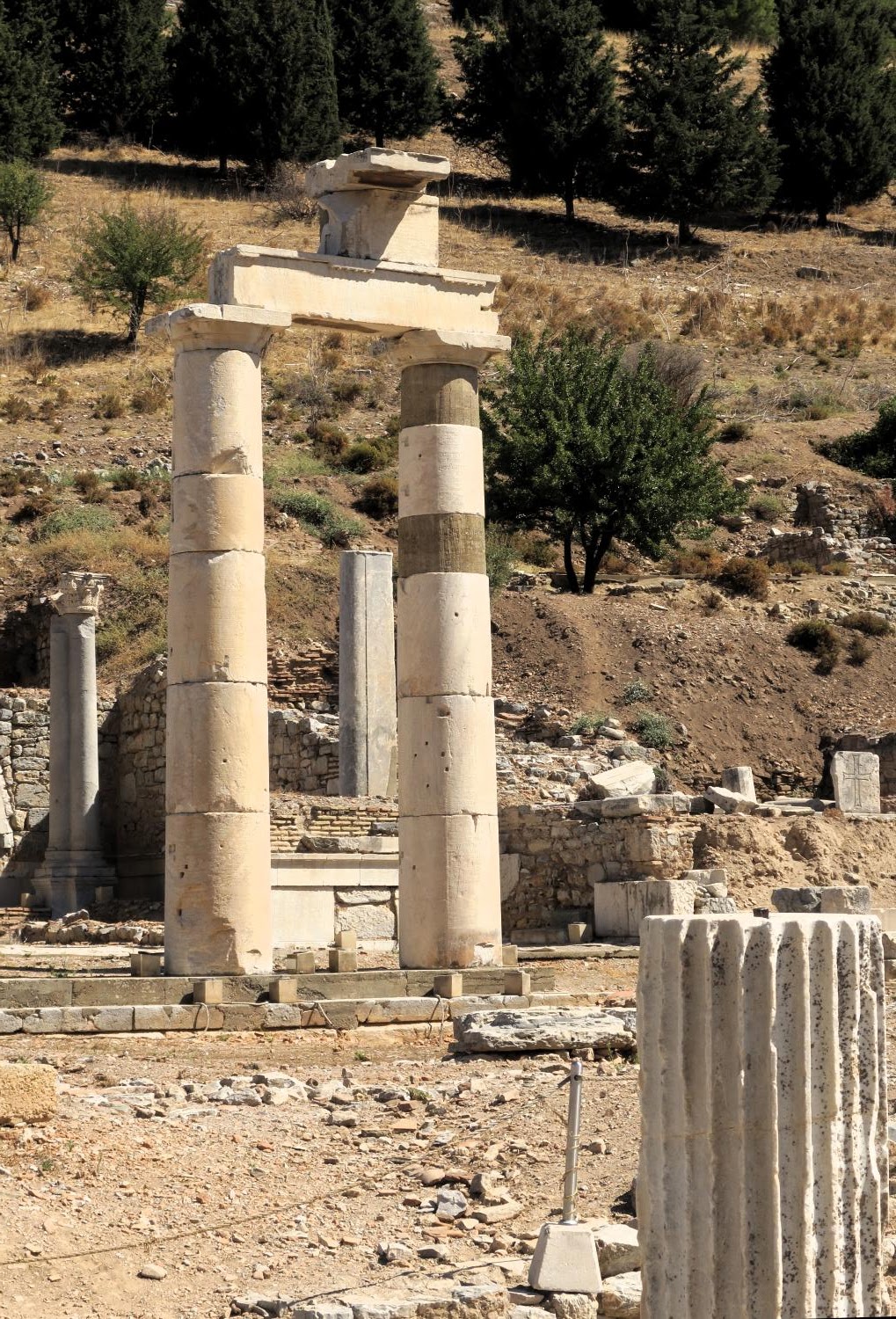
Prytaneion
Odeon or Bouleterion
The small Odeon or Bouleterion is a bit misleading since it is actually quite a size. It dates from the 1st century AD and effectively became City Hall as Ephesus grew.

Odeon
I could so easily imagine myself sitting here and partaking of the latest civic debate. The acoustics here are remarkably good; I found myself listening to someone's private conversation while taking my pictures.

Odeon - a good place to stop and consider your surroundings
Perhaps unsurprisingly it is not just people who use the Odeon to take their ease.

Cat in Congress
I've decided to break my Ephesus blog in various parts to save it becoming overly large and Part 1 ends here. So far we've only just scratched the surface, so if you're interested stay tuned for more of my Visit to Ephesus.

Bored on the beach? Create something different!

The trend toward being artistic while holidaying on a beach has interested me for a while. Over the years I've noted a shift from the traditional sand castle to some pretty amazing sand sculptures, some  made for viewing in daylight:


...and some intended to be viewed after dark:


The beaches on Samos however tend to be mostly stony and as a consequence 'artists' have had to show some versatility. Of course there are lots of stone cairns to be seen:


These little towers seem to spring up pretty much daily and while they are well balanced I don't find them particularly interesting. Just occasionally though you spot something a little more individual, like these chaps:


The tall one on the right reminds me of a child's cartoon character wearing a hat!

Then there was this...


Is it someone's reproduction of a stone circle? It could be, there appears to be entranceway leading to the main construction. Or is it someone laying on their back, those long lines of stones legs with feet pointing upwards?


Whatever it is meant to be I find it interesting. For me it's an ancient stone circle, although not one I'm familiar with. It just has that feel for me. Why not open the images in a new tab, view them full size and explore them for yourself then let me know what you see.

Friday, 22 September 2017

Pythagorion's most famous son

I suspect we can all guess who Pythagorion's most famous son is, but most of us probably didn't know he was a Samian. I refer of course to the man whose theorem is a fundamental relation in Euclidean geometry among the three sides of a right triangle. It states that the square of the hypotenuse (the side opposite the right angle) is equal to the sum of the squares of the other two sides.

Statue of Pythagoras demonstrating his theorem
A statue of Pythagoras adorns the modern Pythagorio waterfront. People look at it and photograph it while muttering the famous right-angled triangle rule to themselves, but I wonder how many realise Pythagoras of Samos was as famous in his own day as a philosopher as a mathematician. The irony is that many of the accomplishments credited to Pythagoras may actually have been accomplishments of his colleagues or successors. Also that it was Pythagoras who styled himself as a philosopher. I don't suppose it really matters much since almost every schoolchild the world over knows the name of Pythagoras today, so genius or charlatan his name has stood the test of time.

Roman baths and athletic area

Walking into modern day Pythagorio, the ancient Samian city of Pythagorion, from our holiday accommodation we would pass the ruins of a second century Roman leisure centre, Thermes.

Roman baths area
I refer to the site as a leisure centre because for me the Thermes was rather more than a bath complex. These Roman baths included an extensive complex of public buildings and baths, which included the gymnasium, the stadium and the palaestra (wrestling school). Next to the main entrance of the baths, there were vestiaires for visitors. The cold water pool and the octagonal pool were located on the northern side of the Thermes, while the hot rooms with an under-floor system for the water heating were located on the southern side.


Sadly I was unable to gain entry to the baths area and was only able to take photographs from the roadway, but as can be seen it must have been an impressive sight in its heyday.


The site included a vaulted room used as a sauna, which was turned into a Christian baptistery in the 5th century AD. That period, a three-aisled basilica with mosaics on the floor was constructed around this baptistery. The walls of the Roman baths were decorated with marble, while the floors were covered with mosaics depicting various scenes.


Adjacent to the baths was the stadium and wrestling school (top right of the image below).


I was able to gain access to this area, which now forms part of the grounds of a hotel complex.

Part of the wrestling school and stadium
As  you can see some of the original construction is still in remarkably good condition.


I think it a shame that a hotel was allowed to be built on what is really such an important archaeological site.


The remains of various chambers can be seen and explored - I was not able to find information explaining what these rooms were originally used for.


I am disturbed by the use the hotel is currently making of pieces of stone removed from the ancient buildings.

Stone removed to make tables and seats
To me it seems very wrong that items are being removed from an archaeological site and used to provide holidaymakers with somewhere to enjoy drinks and snacks.

Tuesday, 19 September 2017

Heraion of Samos - a little more

Visitors exploring the Heraion of Samos will take a walk through history. Archaeological finds have identified many phases of construction dating the from 8th century BC. The Greeks, the Romans and early Christians all used the site. Unfortunately the Heraion served as a quarry through Byzantine times, so that it was eventually dismantled to the very foundations and sadly little information has survived in literary sources.


Despite the willful destruction, there are still plenty of things to see, although some parts of the site have been reclaimed by nature and vegetation hides the remains. Fortunately archeologists have created an area where decorated stones have been gathered for viewing.

Base of a stone bowl

Decorated Column


I believe these two pieces were lintels. Both are propped vertically against a wall, so I have deliberately shown them in the vertical plane.


Some of the stones are decorated in Greek style, some in Roman and yet others have Christian decoration. There are also collections of beautifully finished building blocks.


Architectural elements can be found in various locations of the site. This one in particular caught my eye.

Architectural Element
Remains of an early Christian basilica stand on an area once used by the Romans as a temple.

Christian Basilica
Adjacent to Christian construction, drains from the Roman period can be seen.

Drainage from the Roman Period
There are several areas where both Greek and Roman water pipes and drains are viewable.

Pipework from a Greek water feature
The water feature/fountain was decorated with a dolphin mosaic. The tesserae date from the Greek period.

Dolphin Mosaic
I overheard one visitor saying how disappointed they were with their visit; it made me wonder what they had expected from an archeological site, the majority of which dates from 550 BC? While it's true more could be done to keep the local vegetation at bay, I found the Heraion of Samos an extremely interesting place to visit.

Monday, 18 September 2017

Heraion of Samos - Ionic temple dedicated to Hera

One of the places I was looking forward to visiting while on Samos was the Heraion of Samos. The Heraion of Samos was a large sanctuary to the goddess Hera, located in the southern region of Samos, Greece, approximately 6 km southwest of the ancient city of Pythagoreion. The Late Archaic Heraion of Samos stands in a low, marshy river basin near the sea and was the first of the gigantic free-standing Ionic temples. Earlier erections at this site date back to the Geometric Period of the 8th century BC and earlier.

Entry to the site is gained via an impressive roadway.

Entrance to Heraion of Hera
According to Samian myth, the Goddess Hera was born under a lygos tree. An annual festival known as the Toneia was held, where Hera was symbolically bound with lygos branches.

The Greek poet Homer wrote of her:


An impressive number of buildings once adorned the site with various temples and other constructions being added over the years.

Catalogue of monuments
Site Plan
I'll return to look at some of the other erections at a later date, but today I want to concentrate on the Large Temple of Hera (#1 on the plan).

The one hundred and twelve metre large temple must have been an extremely impressive sight. Today just one column remains standing, but originally there were one hundred and fifty five columns in this temple alone, supporting a gable roof.

Main Temple of Hera
Each of the roof support columns was over twenty one metres tall. Can you imagine what impression that vast building must have had on someone living in a small single room?

Just one of the original one hundred and fifty five columns remains
Each column stood on a base, some were decorative like this one:

Decorated column base
Others were more simple and without decoration. In both cases the column base stood on 'feet.'

Undecorated column base
It's quite hard to get an impression of the size of these bases, I hope this will help:


I can't be absolutely certain, but the Large Temple may have looked something similar to this illustration, although not raised on a plinth:


It was a dipteral temple, that is with a portico of columns two deep, which surrounded it entirely (peripteral). It had a deep square-roofed pronaos in front of a closed cella. Cella and pronaos were divided into three equal aisles by two rows of columns that marched down the pronaos and through the temple. The result was that Hera was worshipped in a temple fitted within a stylized grove of columns, eight across and twenty-one deep. The columns stood on unusual torus bases that were horizontally fluted (see above).


People visiting the Heraion of Samos today have to use their imagination and construct a mental image of what once stood there.


If they can achieve that they will surely be as excited by the site as I was.